The drills have brought together employees from the St. Lucia Red Cross, the National Emergency Management Office (NEMO), the St. Lucia Fire Service, the island’s hospitals and air and sea port personnel.
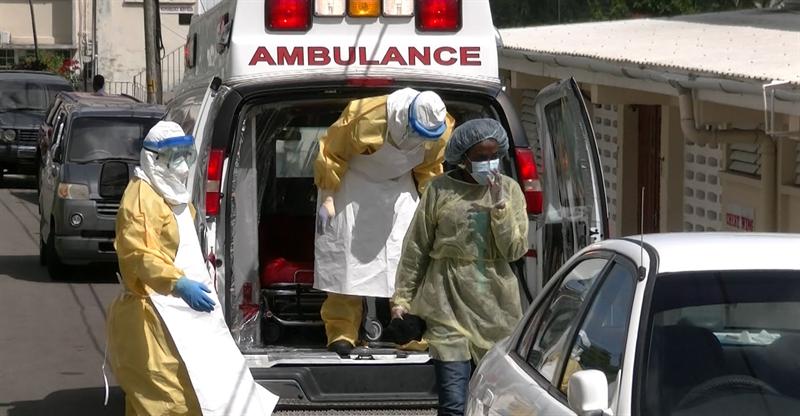 The Ministry of Health, Wellness, Human Services and Gender Relations hosted the first in a new series of Ebola simulations, Monday. The exercise tested St. Lucia’s competencies and the island’s state of readiness to handle a worst case scenario for all diseases of public health concern.
The cross-sector approach brought together employees from Victoria, St. Jude, Dennery and Tapion hospitals, the St. Lucia Red Cross, the National Emergency Management Office (NEMO) and the St. Lucia Fire Service.
“We have had simulations which include both the air and seaports and the hospitals. The aim is to have as many drills as possible so when we have the national simulation exercise persons would already be aware of the procedure,” Dr. Alisha Eugene, Health Disaster Coordinator for the Ministry of Health said.
“In a crisis situation, communication plays a major role in managing fear and expectation,” she continued. “The communication competencies we aim for involve more than providing information to the media. Persons have to alert relevant individuals—there's a chain that information gets filtered through so that everyone gets the same message.
“The communication aspect also has to do with how our Bureau of Health educators and our nurses inform the other patients of what is happening not only to educate them, but also to decrease levels of anxiety and fear.”
Dr. Eugene expressed satisfaction with the outcome of the simulation exercise but added that a more comprehensive assessment will be formed after a debriefing session where the team will discuss the strengths and weaknesses of the simulation exercise.
The exercise tested five competencies: early identification and isolation of a potential Ebola patient; donning and doffing of Personal Protective Equipment (PPE); transfer of the suspected Ebola patient to the Victoria Hospital’s isolation room; contact tracing; and communication between agencies and with the media.