THE PROJECT RECENTLY ENTERED A NEW PHASE WITH A TRAIN-THE-TRAINERS WORKSHOP AND THE INSTALLATION OF THE FIRST WEATHER STATION AT THE SIR ARTHUR LEWIS COMMUNITY COLLEGE
 The National Integrated Planning and Programming Unit (NIPP) is leading a new initiative aimed at strengthening Saint Lucia’s climate resilience through citizen science and environmental monitoring. Under the SALUT Project, weather stations will be installed in schools across the island, allowing students and communities to contribute directly to climate data collection while helping policymakers better understand local environmental conditions.
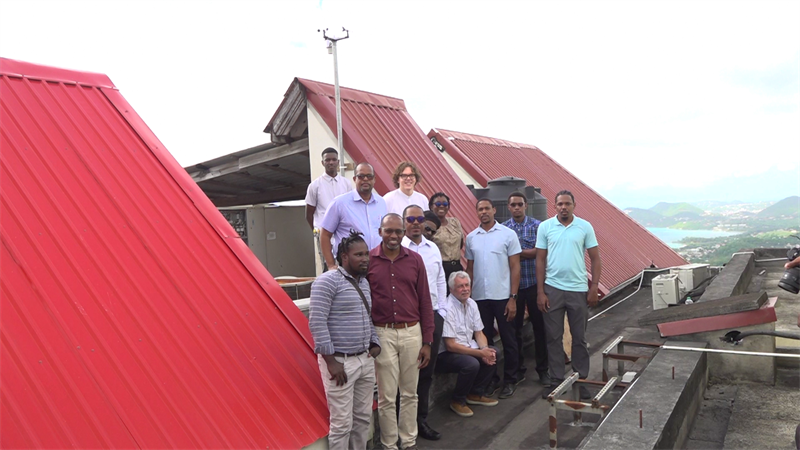
The initiative forms part of the SALUT Project, a collaborative partnership involving NIPP, the Department of Physical Planning, the Sir Arthur Lewis Community College (SALCC), KU Leuven University in Belgium, and the GISIG Association of Italy. The project recently entered a new phase with a train-the-trainers workshop and the installation of the first weather station at the Sir Arthur Lewis Community College.
Director of the National Integrated Planning and Programming Unit, Howard Wells, said the project is designed to encourage citizen science by equipping young people with practical tools to observe and better understand their environment.
“The whole idea is to encourage citizen science. Get young persons, particularly our students, into the whole idea of Earth observation. As you know, climate change is real, but it is as real as you can see it. So we want to get students into the whole business of observing the environment. Where best to start? We felt that the first sensor should be installed at the Sir Arthur Lewis Community College, which is our premier learning institution.”
A key component of the SALUT Project is the establishment of a network of weather stations across Saint Lucia, primarily within schools. These stations will collect localized data on rainfall, wind speed, temperature, and ultraviolet radiation, strengthening climate monitoring while providing valuable hands-on learning opportunities for students.
Representatives from KU Leuven University are currently in Saint Lucia training local stakeholders in the installation and operation of the equipment. Junior Researcher and SALUT Project Co-Coordinator, Evert Van Bever, explained that the weather stations will complement traditional meteorological systems by providing highly localized environmental data.
“These small sensors give us a very dense network where we then can compare local differences. We will use it to teach people and students about weather differences, and we hope it can help us indicate things like storms, local rains and disasters.”
Project officials noted that the weather stations are significantly more affordable than traditional meteorological equipment, making it possible to deploy a larger network across the island and improve access to climate information.
As the lead local agency, NIPP will coordinate the installation of approximately twelve weather stations and support participating schools as they become part of the growing climate observation network. Wells noted that the initiative aligns with NIPP’s broader mandate to strengthen evidence-based planning and promote resilience through innovation, technology, and strategic partnerships.
“We have on board with us teachers and faculty from the Sir Arthur Lewis Community College who will not just be receiving the training on how the sensors are installed, but they will also be part of curricula that we’re hoping to have developed under this project.”
Over the coming months, project partners will work to connect the weather stations to a centralized data platform, enabling educators, researchers, government agencies, and communities to access and analyze climate information in real time.
Van Bever noted that the project will continue over a three-year period, with training and network development activities expanding throughout the island.
“This week, we’ll do some short sessions where we teach the installation of the sensors, and then over the next half year, we’ll train people on how to connect them fully to a sensor network we’re hoping to set up.”
Officials believe the initiative will not only strengthen climate monitoring and disaster preparedness but also foster a culture of environmental awareness, scientific inquiry, and data- driven decision-making among Saint Lucia’s youth.
As climate-related challenges continue to impact Small Island Developing States, NIPP says projects such as SALUT demonstrate the importance of empowering citizens with knowledge and data to support more resilient and sustainable development.
END