THESE INITIATIVES HAVE EQUIPPED FARMERS TO OPERATE MORE SUSTAINABLY WITHIN THE MARKET AND IMPROVE THE QUALITY AND VALUE OF THEIR PROJECTS
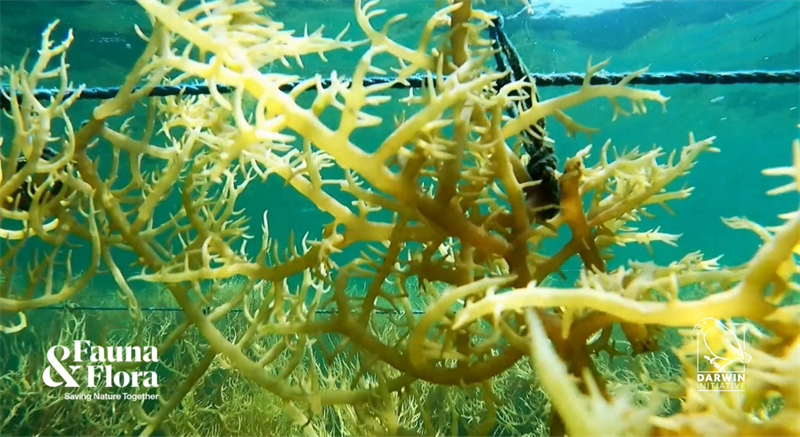 A pioneering UK Government-funded Darwin Initiative project is helping to transform sea moss farming in Saint Lucia, strengthening livelihoods while protecting fragile coastal ecosystems.
Over the past three years, the project ‘Developing Sustainable Sea Moss Farming Methods in Saint Lucia’ has brought together 27 stakeholders across the sector. More than 130 farmers from four major sea moss associations have participated in the project.
Through a series of training sessions, delivered in part with the Global Environment Fund (GEF) Southeast Project, both new and experienced farmers have strengthened their skills in food safety, record-keeping, marketing and value addition. These initiatives have equipped farmers to operate more sustainably within the market and improve the quality and value of their products. Additional support from the British Standards Institution and the Saint Lucia Bureau of Standards has helped major processors and exporters improve efficiency and safety, positioning them to better meet Export Saint Lucia requirements.
Led by the Department of Fisheries, with support from the Japan International Cooperation Agency (JICA), the project has also trialled floating raft and caged sea moss cultivation techniques at key sites in Potwee, Praslin and Savannes Bay, Vieux-Fort (within the Pointe Sables Environmental Protection Area). Traditional monoline methods require multiple anchoring points, often relying on wooden stakes. In contrast, more than 50 farmers have been trained to construct floating rafts using bamboo and PVC, approaches that reduce damage to seagrass beds and coastal ecosystems. These methods also require fewer anchoring points than traditional techniques, which often depend on timber sourced from the dry forest.
While uptake has been gradual, strong farmer support for more sustainable practices signals a steady transition—one that will be reinforced by partners such as the Saint Lucia National Conservation Fund (SLUNCF).
Through strengthened inter-agency collaboration, the project has established a robust baseline for monitoring sea moss production and its environmental impact, with continued support from partners including the Saint Lucia National Trust and relevant government agencies. The project has also laid the groundwork for potential seabed leasing arrangements, which could strengthen farmers’ tenure and encourage long-term investment in the sector. Post-project assessments indicate stronger relationships between stakeholder groups, providing a solid foundation for continued collaboration beyond the life of the project.
Farmer-led citizen science, supported by the Fauna & Flora Arcadia Fund, will enable continued protection and co-management of coastal ecosystems by the communities that depend on them. While the industry remains resilient, mariculture in the Caribbean continues to face significant climate-related risks. Unpredictable sea swells frequently damage cultivation lines, sometimes washing entire harvests away, while rising water temperatures reduce yields, leading to bleaching and loss of crops.
Despite these challenges, farmers remain optimistic about the future of the industry and committed to maintaining a sustainable balance with surrounding mangrove, coral reef and seagrass ecosystems.