The "Declaration of Fort de France" will present a unified voice on the challenges faced by SIDS on climate related issues.
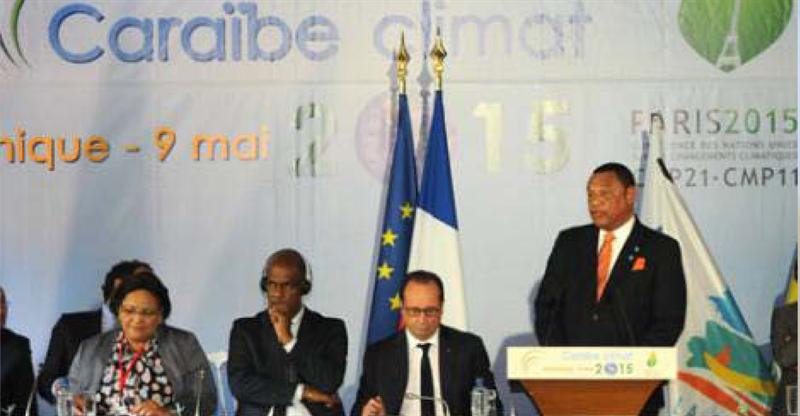 A declaration signed by Caribbean leaders in Martinique on Saturday, appeals to developed countries to help Small Island Developing States (SIDS) mitigate the effects of climate change.
Caribbean heads of state are hoping that the ‘Declaration of Fort de France’ will present a unified voice on the unique challenges of climate related issues experienced in the region.
The tourism-dependent countries have stated that despite their small sizes and negligible contribution to global greenhouse gas emissions, they are among the most vulnerable to the impacts of climate change.
Thirteen Caribbean leaders, including Cuba’s environment minister, attended the one-day summit on May 9, chaired by French President Francois Hollande. The landmark gathering gave regional leaders an opportunity to put forward a joint policy position ahead of the 21st session of the Conference of Parties to the United Nation’s Framework Convention on Climate Change in Paris in December.
Chairman of the nine-member Organization of Eastern Caribbean States (OECS), Dominica’s Prime Minister Roosevelt Skerrit, said the summit gave the islands a chance to ensure that the concerns of the Caribbean receive due prominence in the Paris talks, because climate change is an issue that affects the very survival of SIDS.
"The global goal of limiting average temperature increase to no more than 2 degrees Celsius above pre-industrial levels is inadequate for protecting the fragile ecosystems of SIDS from the adverse impacts of climate change," he said. "A target rate of less than 1.5 degrees Celsius would be more appropriate.
"We are painfully aware that in the Caribbean, some ecosystems are already approaching the limits of their adaptive capacities, presenting major challenges for the livelihoods of the people. We therefore reiterate the call for urgent and ambitious action by developed country parties in particular, geared toward achieving this target."
Chairman of the Caribbean Community (CARICOM), Bahamian Prime Minister Perry Christie, spoke of the urgent need to close the gap between the mitigation emitters and the level of effort required to decrease the global average temperature.
“Any Paris outcome must include clarity on ambitious targets for developed countries, and clarity on the adaptation measures and resources required to facilitate and enhance the sustainable development plans and programs of SIDS,” he said.
Meanwhile, President Hollande urged “rich countries to help poor countries fight global warming."
Dr. Timothy Harris, Prime Minister of Saint Kitts and Nevis commented that because climate change is one of the most important issues of our day, people must ensure that they coexist with their environments.
"We must work together as Caribbean neighbors to impress upon the world that we are interdependent. No man is an island. We need one another."
The landmark summit afforded regional leaders an opportunity to state a joint policy position ahead of the United Nations Framework Convention on Climate Change (UNFCCC) COP21 meeting to be held in Paris, in November and December.