OUR RESPONSE CONTINUES TO FOCUS ON PREVENTION, PREPAREDNESS, AWARENESS, PUBLIC SAFETY, AND A COORDINATED EMERGENCY RESPONSE, STATED BY THE ACTING CHIEF FOREST OFFICER, DR. GUSTAVE
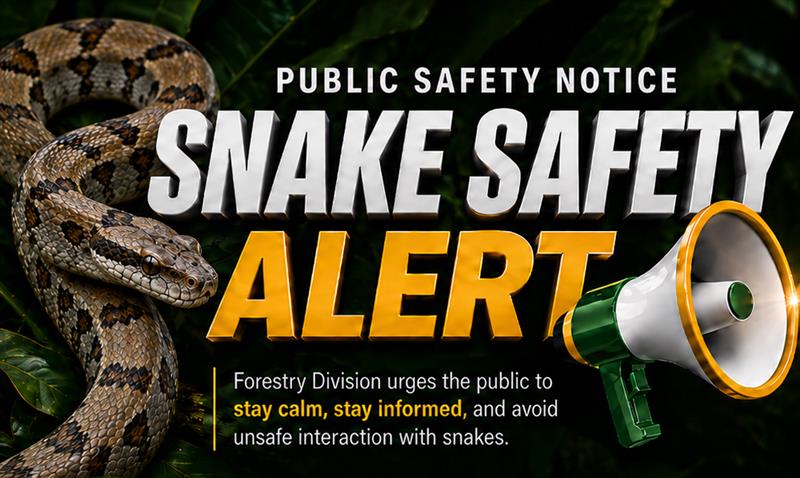 The Department of Agriculture, Fisheries and Food Security, through the Forestry Division, reassures the public that the Government of Saint Lucia continues to manage snake encounters and snakebite risks through a calm, coordinated, scientific, and responsible national response framework focused on public safety, preparedness, and risk reduction. Acting Chief Forest Officer, Dr. Donatian Gustave, emphasized that while the Saint Lucia Fer-de-Lance (Bothrops caribbaeus), locally known as the “Sepan,” is an endemic species found nowhere else in the world, the safety and well-being of citizens remain the Government’s foremost national priority.
“The Forestry Division fully recognizes the fear and concern being experienced by many citizens, particularly within rural and farming communities where encounters may occur more frequently. Our response continues to focus on prevention, preparedness, awareness, public safety, and a coordinated emergency response,” stated Dr. Gustave. The Department further cautions the public against the spread of misinformation relating to snakes and snake sightings circulating on social media platforms. Several images and videos currently being shared, including AI-generated content, have been identified as false, misleading, or inaccurately representing snake incidents in Saint Lucia.
“We strongly encourage members of the public to rely only on official Government communication channels and advisories issued by the Forestry Division,” Dr. Gustave added. Department of Agriculture Unveils National Snake Risk Management Framework Focused on Public Safety
The Forestry Division reiterated several key national positions:
- Public safety remains the priority through prevention, awareness, appropriate protective equipment, strengthened response systems, and timely medical treatment;
- The Government’s approach is centered on risk reduction, education, preparedness, scientific management, and a coordinated response.
National efforts are currently focused on:
- Improving community awareness and public education through island-wide public consultations;
- Strengthening emergency response systems in coordination with the Ministry of Health;
- Promoting vegetation management and environmental sanitation in high-risk communities;
- Reducing rodent attractants around homes, farms, and public spaces through island-wide cleanups;
- Supporting safer farming and outdoor practices through acquisition of protective equipment for farmers and outdoor workers;
- Encouraging the use of protective footwear, lighting, and safe field practices;
- Exploring environmentally responsible deterrence measures around homes, public buildings, and other vulnerable locations, including maintaining short vegetation, and clearing areas of debris and dense vegetation;
- Launching of Trained Community Snake Safety Responders to capture and contain the reptiles;
- Strengthening rapid reporting and response coordination through Forestry personnel and emergency services;
- Reducing panic, misinformation, and unsafe interactions with snakes.
The public is advised to:
- remain calm during snake encounters;
- avoid attempting to handle snakes;
- slowly move away from the area;
- immediately contact the Forestry Division or emergency services where assistance is required.
The Forestry Division is also intensifying public education regarding the differences between the non-venomous Saint Lucia Boa and the venomous Fer-de-Lance, as confusion between the two species continues to contribute to fear and misinformation.
The Division further reminds the public that many snakebite incidents occur during intentional interaction with snakes, including attempts to kill, corner, or handle them. Citizens are therefore encouraged to maintain clean surroundings, reduce overgrown vegetation near homes and farms, properly store waste and food sources that may attract rodents, utilize protective footwear and lighting when outdoors, and exercise caution in areas with dense vegetation, debris, rocks, or wood piles. In the event of a snakebite, immediate medical attention must be sought. Anti-venom remains available through the health system, and treatment delays should be avoided.
The Forestry Division maintains an active network of Forestry personnel accessible through the following wild life officers stationed across the five forest ranges of Millet, Dennery, Northern, Quillesse, and Soufriere. These teams remain available to receive reports and, where necessary, safely assess and respond to snake sightings:
- Northern Range – 758-715-7548
- Millet Range – 758-519-0787
- Dennery – 758-518-5290 / 758-720-4295
- Quillesse Range (V. Fort) – 758-729-6912
- Soufriere Range – 758-720-8915 / 758-518-1478
In the event of an emergency where medical intervention is needed, the public is urged to contact 911 or seek immediate medical attention at Owen King EU Hospital in Castries or St. Jude Hospital in Vieux Fort as these are the two medical institutions currently equipped to administer the life-saving antivenin. The Forestry Division remains committed to continued collaboration with the Ministry of Health, Department of Sustainable Development, NEMO, Saint Lucia Solid Waste Management Authority, Fire Service, Royal Saint Lucia Police Force, Government Information Service, community organizations, and the wider public to reduce risk, improve preparedness, and strengthen national resilience.