The one-year pilot project focused on greenhouse gas (GHG) emissions from crop production
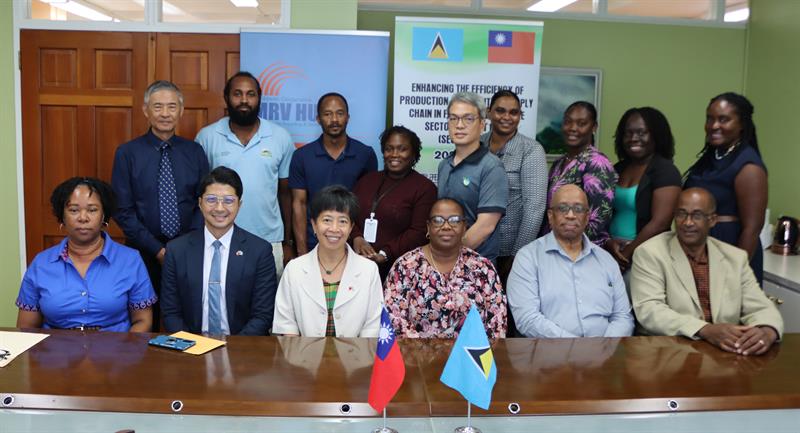 Officials from the Taiwan Technical Mission (TTM) in Saint Lucia, the Department of Agriculture, Fisheries and Food Security, and Caribbean Cooperative Measurement, Reporting and Verification Hub (CCMRVH) met recently to evaluate the findings of a project aimed to improve data collection and analysis in Saint Lucia’s agricultural sector.
The one-year pilot project focused on greenhouse gas (GHG) emissions from crop production and introduced tools and methods to support better agricultural decision-making and climate reporting under the United Nations Framework Convention on Climate Change (UNFCCC).
The project addressed both climate impacts and food security in the agricultural sector, and builds on earlier efforts by the Taiwan Technical Mission (TTM) that have improved crop production and reduced food import dependency. It also aligns with the goals of Saint Lucia’s Sectoral Adaptation and Action Plan for the Agriculture Sector (SASAP), and is intended to be replicated in other Caribbean islands.
Project objectives include:
Improving data collection methodologies and tools for agricultural GHG emissions accounting;
Establishing demonstration plots to assess the impacts of selected mitigation measures on crop production systems;
Enhancing national capacity for transparent GHG reporting and improved agricultural data management; and
Supporting climate-smart agriculture initiatives and evidence generation to inform national climate and development priorities.
During the results presentation meeting held on Thursday morning, March 19, 2026, at the IICA Conference Room in the Sir Stanislaus James Building on the Castries Waterfront, officials agreed that the project was a step closer to addressing the climate change challenges within Saint Lucia’s agricultural sector.
H.E. Nicole Su, Taiwan’s Ambassador to Saint Lucia, recalled witnessing the signing of the Memorandum of Understanding for the project in February last year, which signaled the start of the important partnership. She said she was pleased that, under the auspices of the Ministry of Agriculture, the project was implemented smoothly and had delivered impressive results during the past year.
Ambassador Su noted that by bringing together CCMRV Hub’s expertise in measurement, reporting and verification, and the Taiwan Technical Mission’s experience in agricultural development, steady progress has been made to advance climate-resilient agriculture in Saint Lucia. She added that the project has strengthened local capacity for greenhouse gas data collection and analysis, while promoting more data-driven approaches to agricultural practices.
“In addition to the challenge of climate change, we are now facing a volatile time in the international situation,” Ambassador Su said. “Unfortunately, these are further contributing to the threat to food security. Therefore, it is important that we take measures to strengthen our resilience. For this, I’m glad that this project is the crucial first step towards building the sustainable development for food security in Saint Lucia.”
Under the project, a series of activities were hosted, including data collection workshops, where participants became familiarized with the fundamentals of greenhouse gas (GHG) emissions, data collection methodologies, and the use of the iFarm system.
Ambassador Su said she was impressed that pilot demonstration sites have been established to scientifically monitor the differences of the greenhouse gas emission by different agricultural practices, such as tunnel greenhouse systems and conventional farming plots.
“Most importantly, through this project, I’m happy to learn that practical tools, such as data collection templates and estimation methods have been developed, so that the journey of resilience-building can continue with the support of science, providing a solid foundation for evidence-based policy-making in Saint Lucia,” she explained.
Ambassador Su thanked the Ministry of Agriculture for considering further bilateral cooperation on climate change adaptation, natural disaster mitigation, and rural development. Coupled with the project with CCMRV Hub, she said these are all efforts reflecting a shared commitment to advance sustainable development through translating research into practical applications. She also thanked the CCMRVH, the Ministry of Agriculture, and all implementing partners who contributed to the success of the project.
Dr. Randel Esnard, Deputy Permanent Secretary in the Department of Agriculture, Fisheries and Food Security, said he has long been an advocate for the Ministry placing more focus on mitigation – and not just adaptation – to climate change. For this to happen, key drivers within the Ministry will be needed to do achieve that goal, he said.
“For the Ministry, it’s really about giving us another opportunity to develop the sector and not just focus on adaptation, but also looking at the core benefits of adaptation and mitigation, and how we can use that to address some of the challenges we face with regards to climate change,” he explained.
He added: “What we’re trying to do here is build capacity within the Ministry of Agriculture – in both the crop and livestock sectors – to really address the issues and to continue the sustainability of production. I’m pretty much interested to see the results and see how best the officers can take it up and create new initiatives and opportunities for themselves in that space.”
With the Ministry of Agriculture now including the Department of Sustainable Development, Dr. Esnard noted that the time is opportune for the Ministry to address mitigation as it relates to climate change.
“The whole issue of mitigation when it comes to climate change should not be transportation and energy alone; agriculture has a very big part to play in that,” he said. “Even if we’re a small island developing state and our contribution to greenhouse gas emission is very low, there are still things that we can do in that mitigation space.”
For his part, Mr. Crispin d’Auvergne, Executive Director of the Caribbean Cooperative Measurement, Reporting and Verification Hub (CCMRVH), believes that agriculture is literally the fuel of human survival as well as a major driver of social advancement and technological innovation. However, he acknowledged that in many instances in history, a country’s ability or inability to feed its citizens has determined its long-term survival or demise.
“We are in an era of interesting times -- maybe a little too interesting for most of us -- marked by geopolitical uncertainty, conflict and supply chain disruptions, to name a few,” Mr. d’Auvergne stated. “This rapid and unpredictable reshaping of the geopolitical map is occurring against the backdrop of warming world and changing climate. Together, they are jeopardizing food and nutritional security in many parts of the world, including ours.”
These challenges, d’Auvergne advised, underscore the need to urgently work to enhance food security at the national level, including applying climate-resilient, low emission approaches in food production.
“The Climate Impact & Data Enhancement Project has looked to improve data collection for agricultural greenhouse gas emissions in Saint Lucia by comparing production results between two conventional farm plots and two hoop greenhouses,” he explained. “The field experiments have also incorporated the use of solar-powered and fuel-powered water pumps.”
The importance of the research undertaken and the associated findings should not be taken lightly, d’Auvergne added. He said that, if given due consideration, they can meaningfully inform national agricultural policy and practice, enhance climate reporting on future mitigation and adaptation strategies, and strengthen the research and data culture, all of which are critical for informing decision-making and promoting technological advancement.